How to Convert Length Into Meters
To convert a length into meters, multiply or divide the original value by the correct conversion factor. For example, 1 foot equals 0.3048 meters, while 1 kilometer equals 1,000 meters.
If you want instant and error-free calculations, you can also use our Length Converter Tool to convert between metric and imperial units in seconds without performing manual calculations.
Table of Contents
What Is a Meter?
A meter (m) is the standard unit of length in the International System of Units (SI). It is used around the world to measure distance, height, width, depth, and many other physical dimensions.
The meter is officially defined within the International System of Units (SI), which provides a globally accepted framework for measurement. This standard ensures that scientists, engineers, manufacturers, and educators around the world use the same precise definitions, making international collaboration and technical communication much more reliable.
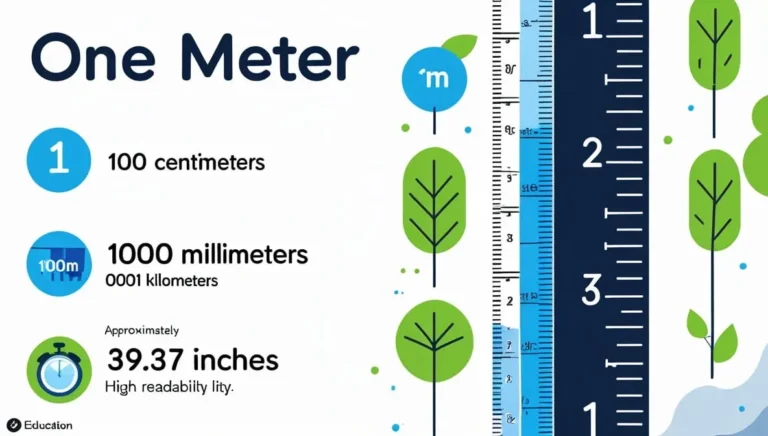
Scientists, engineers, architects, surveyors, manufacturers, and educators all rely on meters because they provide a universal and consistent way to measure length.
Unlike some regional measurement systems, the meter is internationally recognized, making it easier to exchange technical information, conduct scientific research, and complete engineering projects accurately.
Meter at a Glance
| Property | Value |
|---|---|
| Unit Name | Meter (Metre) |
| Symbol | m |
| Measurement Type | Length |
| Measurement System | International System of Units (SI) |
| Standard | Internationally Accepted |
Why Convert Length Into Meters?
Different countries and industries use different measurement systems.
For example:
- The United States commonly uses feet and inches.
- Most European countries use meters and centimeters.
- Aviation often uses nautical miles.
- Engineering drawings may contain multiple unit systems.
- Manufacturing documents frequently require metric measurements.
Accurate length conversion depends on using official measurement standards rather than rounded or outdated values. Whether you’re working on a school assignment, engineering project, or manufacturing process, relying on internationally recognized conversion factors helps ensure consistent and dependable results.
Converting everything into meters creates a common reference that reduces confusion and improves accuracy.
Benefits of Converting to Meters
- Universal measurement standard
- Easier engineering calculations
- Better scientific accuracy
- Consistent construction measurements
- Simplified international communication
- Compatible with most technical software
Metric vs Imperial System
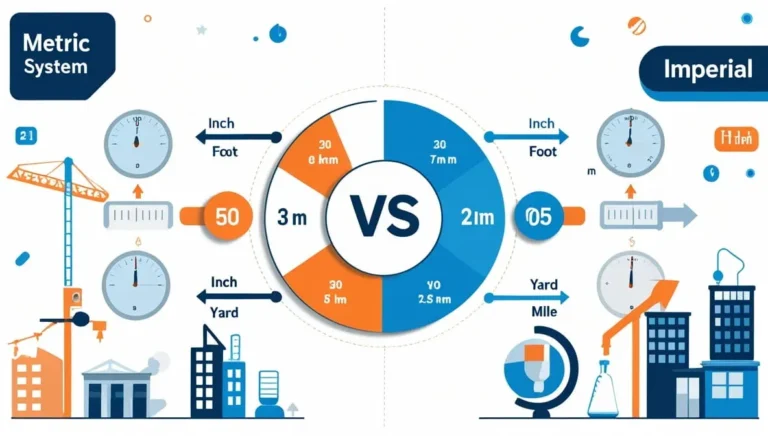
Understanding the differences between these two systems helps prevent conversion errors.
| Metric System | Imperial System |
|---|---|
| Meter | Foot |
| Kilometer | Mile |
| Centimeter | Inch |
| Millimeter | Fraction of an Inch |
| Decimal-based | Fraction-based |
| International Standard | Primarily Used in the US |
If you’re learning how different metric units relate to one another, our metric conversion guide explains another practical conversion with step-by-step examples.
Why the Metric System Is Preferred
The metric system is easier to calculate because every unit changes by a multiple of ten.Understanding unit conversions becomes easier once you learn the same principles used in converting kilograms to pounds, where fixed conversion factors are also applied.
For example:
- 100 centimeters = 1 meter
- 1,000 meters = 1 kilometer
No complicated fractions are required.
If you’re also converting mass or weight measurements alongside length, our Weight Converter Tool can help you switch between common metric and imperial weight units just as easily.
How to Convert Length Into Meters
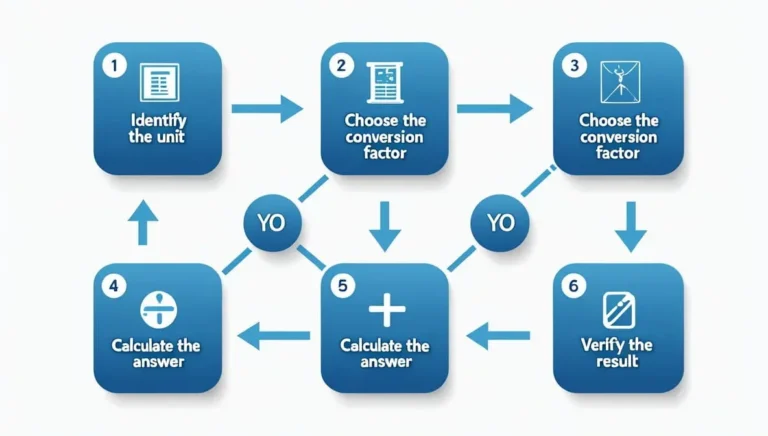
Converting any measurement into meters follows the same basic process.
Step 1: Identify the Original Unit
Determine whether the measurement is:
- Feet
- Inches
- Miles
- Yards
- Centimeters
- Millimeters
- Kilometers
- Another unit
Example:
25 feet
Step 2: Find the Correct Conversion Factor
Each unit has an exact conversion factor.
Examples include:
- 1 foot = 0.3048 meters
- 1 inch = 0.0254 meters
- 1 yard = 0.9144 meters
- 1 mile = 1609.344 meters
Step 3: Multiply or Divide
Apply the appropriate formula.
Example:
25 feet
25 × 0.3048
= 7.62 meters
Step 4: Round Only When Necessary
If you’re working on:
- School assignments
- Scientific calculations
- Engineering drawings
- Manufacturing specifications
avoid rounding too early.
Use the full conversion value throughout the calculation and round only at the final step.
Step 5: Verify the Result
Double-check your answer using:
- A scientific calculator
- Spreadsheet formulas
- An online length converter
- Engineering software
Verification helps prevent costly mistakes, especially in professional applications.
Common Real-Life Examples of Meter Conversions
Many people learn unit conversions more easily when they see practical examples. Meter conversions are used every day to measure room dimensions, road distances, furniture sizes, sports fields, building materials, and product dimensions. For example, a 6-foot person is approximately 1.83 meters tall, while a 5-kilometer running route equals 5,000 meters. Understanding these everyday examples helps users apply conversion formulas correctly and makes it easier to estimate measurements without relying entirely on a calculator.
Understanding practical applications makes conversion easier.
Example 1: Home Improvement
A doorway measures 84 inches.
84 × 0.0254 = 2.1336 meters
Knowing the measurement in meters helps when purchasing doors internationally.
Example 2: Construction
A room is 18 feet long.
18 × 0.3048 = 5.4864 meters
Construction drawings often require metric measurements even when the original plans use feet.
Example 3: Running Track
A runner completes 5 kilometers.
5 × 1000 = 5,000 meters
This conversion is useful for race organizers and fitness tracking.
Example 4: Travel
The destination is 12 miles away.
12 × 1609.344 = 19,312.128 meters
Navigation software may internally use meters for route calculations.
Example 5: Manufacturing
A metal rod measures 750 millimeters.
750 ÷ 1000 = 0.75 meters
Manufacturers often switch between millimeters and meters depending on the project.
Length Conversion Formula
The general formula is:
Length in meters = Original value × Conversion factor
When converting from a larger metric unit, such as kilometers:
Meters = Kilometers × 1000
When converting from centimeters:
Meters = Centimeters ÷ 100
When converting from millimeters:
Meters = Millimeters ÷ 1000
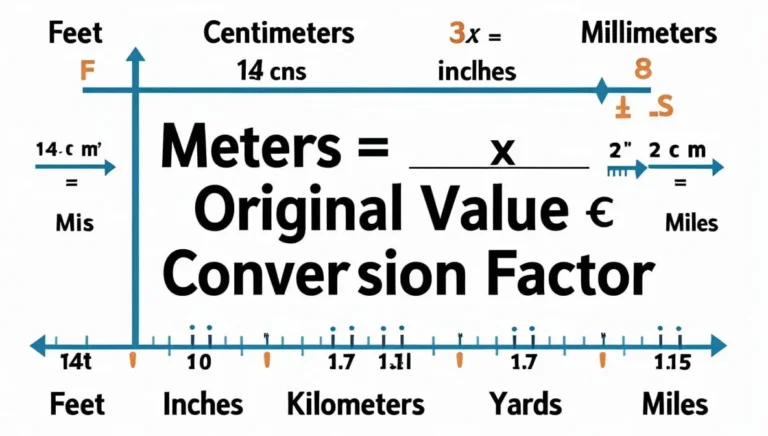
Common Length Units That Can Be Converted to Meters
Almost every commonly used length unit can be converted into meters using a fixed conversion factor. These include millimeters (mm), centimeters (cm), inches (in), feet (ft), yards (yd), kilometers (km), and miles (mi). Each unit has a predefined relationship with the meter, making conversions accurate and consistent worldwide. Learning these relationships helps users quickly switch between metric and imperial measurements for academic, professional, and everyday tasks.
Understanding Length Units
Before converting measurements, it’s helpful to understand the most common units.
Metric Units
The metric system is based on powers of ten, making conversions straightforward.
| Unit | Symbol | Equivalent |
|---|---|---|
| Millimeter | mm | 0.001 m |
| Centimeter | cm | 0.01 m |
| Decimeter | dm | 0.1 m |
| Meter | m | 1 m |
| Kilometer | km | 1000 m |
Because each unit differs by a factor of 10, metric conversions are generally quick and easy.
Imperial Units
The imperial system is still widely used in certain countries.
Common units include:
- Inch (in)
- Foot (ft)
- Yard (yd)
- Mile (mi)
Unlike the metric system, imperial conversions require fixed conversion constants rather than simple decimal shifts.
Complete Length Conversion Table
| Unit | Conversion to Meters |
|---|---|
| 1 Millimeter | 0.001 m |
| 1 Centimeter | 0.01 m |
| 1 Decimeter | 0.1 m |
| 1 Meter | 1 m |
| 1 Kilometer | 1000 m |
| 1 Inch | 0.0254 m |
| 1 Foot | 0.3048 m |
| 1 Yard | 0.9144 m |
| 1 Mile | 1609.344 m |
| 1 Nautical Mile | 1852 m |
| 1 Micrometer | 0.000001 m |
| 1 Nanometer | 0.000000001 m |
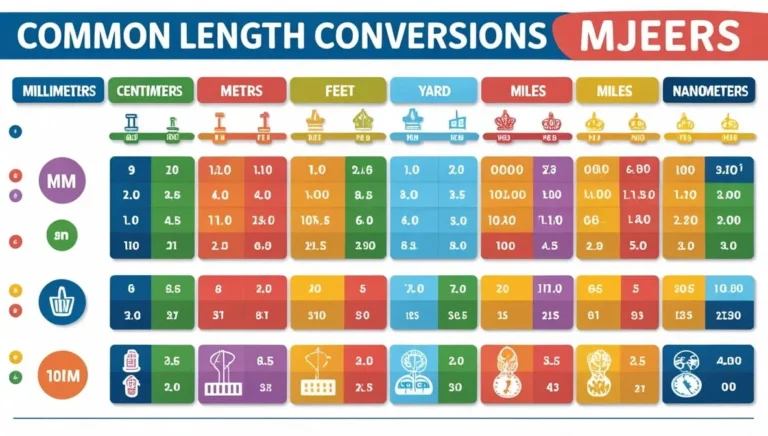
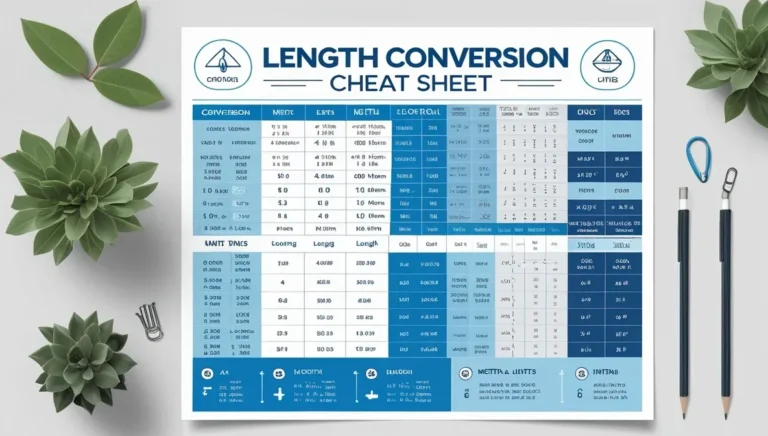
This table can serve as a quick reference whenever you need to convert measurements into meters.
If you regularly work with different measurement systems, our measurement converter lets you convert multiple units instantly without memorizing conversion factors.
Common Length Conversions Explained
Feet to Meters
Formula:
Feet × 0.3048
Examples:
- 1 ft = 0.3048 m
- 5 ft = 1.524 m
- 10 ft = 3.048 m
- 50 ft = 15.24 m
- 100 ft = 30.48 m
This conversion is commonly used in construction, architecture, sports, and real estate.
Inches to Meters
Formula:
Inches × 0.0254
Examples:
- 12 inches = 0.3048 m
- 24 inches = 0.6096 m
- 36 inches = 0.9144 m
- 48 inches = 1.2192 m
Inches are frequently used for product dimensions, furniture, electronics, and manufacturing.
Centimeters to Meters
Formula:
Centimeters ÷ 100
Examples:
- 50 cm = 0.5 m
- 100 cm = 1 m
- 250 cm = 2.5 m
- 500 cm = 5 m
Because the metric system uses powers of ten, this is one of the simplest conversions.
Millimeters to Meters
Millimeters (mm) are commonly used when measuring very small objects or precise dimensions. You’ll see this unit in engineering, manufacturing, machining, medical devices, and product specifications.
Formula
Meters = Millimeters ÷ 1,000
Examples
| Millimeters | Meters |
|---|---|
| 1 mm | 0.001 m |
| 10 mm | 0.01 m |
| 100 mm | 0.1 m |
| 500 mm | 0.5 m |
| 1,000 mm | 1 m |
| 2,500 mm | 2.5 m |
Example Calculation
Convert 850 mm into meters.
850 ÷ 1,000 = 0.85 m
Kilometers to Meters
Kilometers are used for measuring long distances, such as roads, highways, marathons, and geographical locations.
Formula
Meters = Kilometers × 1,000
Examples
| Kilometers | Meters |
|---|---|
| 0.5 km | 500 m |
| 1 km | 1,000 m |
| 2 km | 2,000 m |
| 5 km | 5,000 m |
| 10 km | 10,000 m |
Example Calculation
Convert 3.8 km into meters.
3.8 × 1,000 = 3,800 meters
Yards to Meters
Yards are still commonly used in sports, landscaping, and some construction projects.
Formula
Meters = Yards × 0.9144
Examples
| Yards | Meters |
|---|---|
| 1 yd | 0.9144 m |
| 5 yd | 4.572 m |
| 10 yd | 9.144 m |
| 25 yd | 22.86 m |
| 100 yd | 91.44 m |
Example
A football field section measures 30 yards.
30 × 0.9144 = 27.432 meters
Miles to Meters
Miles are mainly used for road distances in countries that follow the imperial system.
Formula
Meters = Miles × 1609.344
Examples
| Miles | Meters |
|---|---|
| 1 | 1,609.344 |
| 2 | 3,218.688 |
| 5 | 8,046.72 |
| 10 | 16,093.44 |
| 25 | 40,233.6 |
Example
Convert 7 miles into meters.
7 × 1609.344 = 11,265.408 meters
Nautical Miles to Meters
A nautical mile is different from a standard mile and is primarily used in aviation and marine navigation.
Formula
Meters = Nautical Miles × 1852
Examples
| Nautical Miles | Meters |
|---|---|
| 1 | 1,852 |
| 2 | 3,704 |
| 5 | 9,260 |
| 10 | 18,520 |
Micrometers to Meters
Micrometers (µm) measure extremely small dimensions.
Formula
Meters = Micrometers ÷ 1,000,000
Example
250,000 µm = 0.25 m
Micrometers are widely used in:
- Medical research
- Biology
- Semiconductor manufacturing
- Precision engineering
Nanometers to Meters
Nanometers are one-billionth of a meter.
Formula
Meters = Nanometers ÷ 1,000,000,000
Example
500,000,000 nm = 0.5 m
Nanometers are commonly used in:
- Nanotechnology
- Chemistry
- Physics
- Electronics
- Optical engineering
Manual Conversion vs. Online Converter
Both methods are useful, but each serves different needs.
| Manual Conversion | Online Converter |
|---|---|
| Helps you understand calculations | Provides instant results |
| Suitable for learning | Ideal for speed |
| No internet required | Requires internet access |
| Easy for simple conversions | Handles multiple units automatically |
| Better for exams | Better for professional workflows |
When to Convert Manually
Manual calculations are ideal when you:
- Are preparing for exams
- Need to understand the process
- Want to verify software results
- Are solving mathematical problems
When to Use an Online Converter
An online converter is the better choice when you:
- Convert measurements frequently
- Need instant answers
- Work with many different units
- Require high precision
- Want to reduce calculation errors
Industry Applications
Length conversion is part of everyday work across many professions.
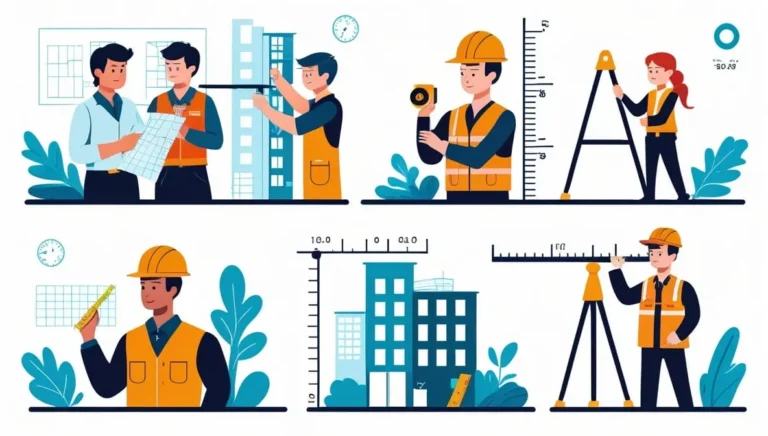
Engineering
Engineers rely on accurate meter conversions for:
- Structural design
- Machine components
- Mechanical systems
- Civil engineering projects
Even small conversion errors can affect safety and performance.
Professionals working with timber and woodworking projects may also find our Board Feet Calculator useful for estimating lumber volume accurately.
Architecture
Architects frequently convert between feet, inches, and meters when working on international projects.
Using meters creates consistency across construction drawings and building specifications.
Construction
Builders convert measurements to:
- Estimate materials
- Mark layouts
- Install structural elements
- Verify dimensions
Accurate conversions help reduce waste and prevent costly mistakes.
Education
Students encounter length conversions in:
- Mathematics
- Physics
- Chemistry
- Geography
- Engineering courses
Understanding the conversion process improves problem-solving skills and exam performance.
Manufacturing
Factories use meter-based measurements for:
- Product dimensions
- Machine calibration
- Quality control
- Technical documentation
Consistency ensures products meet design specifications.
Science and Research
Scientists use meters because they are part of the International System of Units (SI), enabling standardized data collection and collaboration worldwide.Scientists often work with multiple measurement systems.Besides length, understanding Kelvin to Fahrenheit conversion is essential for laboratory and research work.
Scientific calculations often involve both length and temperature measurements. Our Degree Converter Tool makes it easy to convert between Celsius, Fahrenheit, and Kelvin.
Precision is essential in scientific measurements, especially in fields such as space exploration, physics, and engineering research. Even the smallest measurement error can affect calculations, experiments, and mission planning, which is why standardized metric units are widely used in scientific organizations around the world.
Choosing the Best Conversion Method
The right approach depends on your situation.
| Your Goal | Best Option |
|---|---|
| Learn the concept | Manual calculation |
| Solve homework | Manual calculation |
| Verify answers | Manual + calculator |
| Convert quickly | Online converter |
| Handle large datasets | Spreadsheet formulas |
| Professional design work | Engineering software |
If your projects involve both linear and surface measurements, you can also use our Area Converter Tool to convert square measurement units accurately.
Common Mistakes to Avoid
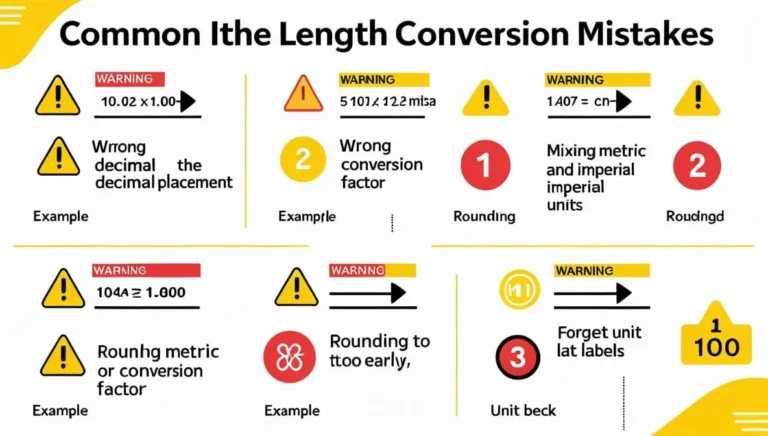
Avoiding these mistakes will improve the accuracy of your conversions.
1. Using the Wrong Conversion Factor
Always verify that you’re using the correct factor for the unit you’re converting.
2. Mixing Metric and Imperial Units
Don’t combine centimeters with inches or feet with meters in the same calculation without converting first.
3. Rounding Too Early
Keep full precision until the final result to avoid cumulative errors.
4. Forgetting Unit Labels
Always include the correct unit symbol (m, cm, mm, ft, in, etc.) to avoid confusion.
5. Confusing Miles with Nautical Miles
A standard mile and a nautical mile are different units with different conversion factors.
Best Practices for Accurate Conversions
Follow these habits to reduce errors and improve efficiency:
- Identify the original unit before calculating.
- Use exact conversion factors whenever possible.
- Double-check decimal placement.
- Keep extra decimal places during calculations.
- Verify important measurements with a trusted calculator or converter.
- Use official SI units in technical and scientific work.
- Save a printable conversion chart for quick reference.
- When working in spreadsheets, use formulas instead of manual entry to reduce mistakes.
Practicing with different measurement conversion examples helps you become more confident when switching between metric units.
Quick Reference Length Conversion Chart
Keep this table handy whenever you need to convert common length units into meters.
| Unit | Equals in Meters |
|---|---|
| 1 Millimeter (mm) | 0.001 m |
| 1 Centimeter (cm) | 0.01 m |
| 1 Decimeter (dm) | 0.1 m |
| 1 Meter (m) | 1 m |
| 1 Kilometer (km) | 1,000 m |
| 1 Inch (in) | 0.0254 m |
| 1 Foot (ft) | 0.3048 m |
| 1 Yard (yd) | 0.9144 m |
| 1 Mile (mi) | 1,609.344 m |
| 1 Nautical Mile (nmi) | 1,852 m |
| 1 Micrometer (µm) | 0.000001 m |
| 1 Nanometer (nm) | 0.000000001 m |
Metric Prefix Reference
Understanding metric prefixes makes conversions much easier because every step is based on powers of ten.
| Prefix | Symbol | Relationship to Meter |
|---|---|---|
| Nano | nm | 0.000000001 m |
| Micro | µm | 0.000001 m |
| Milli | mm | 0.001 m |
| Centi | cm | 0.01 m |
| Deci | dm | 0.1 m |
| Meter | m | 1 |
| Kilo | km | 1,000 m |
When Should You Convert to Meters?
Converting measurements into meters is useful whenever consistency and accuracy matter.
Common situations include:
- Engineering projects
- Construction planning
- Scientific experiments
- School assignments
- Product manufacturing
- International shipping
- Architecture drawings
- Surveying land
- Sports measurements
- Geographic mapping
Using meters ensures everyone is working with the same internationally recognized unit.
Manual Conversion Checklist
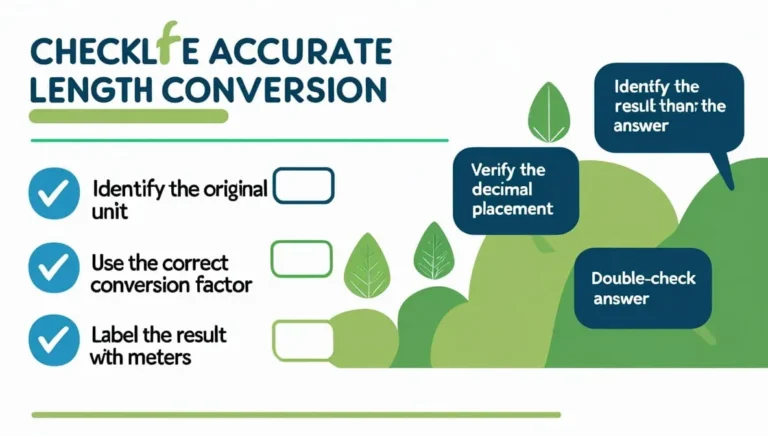
Before finalizing your calculation, ask yourself:
✅ Did I identify the correct starting unit?
✅ Am I using the correct conversion factor?
✅ Have I kept enough decimal places?
✅ Did I label the answer with m?
✅ Have I verified the result?
Following this checklist helps prevent common conversion errors.
Frequently Asked Questions (FAQ’s):
Can I convert meters back into other units?
Yes. You can easily convert meters into other length units by multiplying the value in meters by the appropriate conversion factor. For example, multiply meters by 100 to get centimeters, by 1,000 to get millimeters, or by 3.28084 to convert meters into feet. To convert meters into kilometers, divide the value by 1,000.
Converting from meters is common in engineering, construction, education, manufacturing, and everyday measurements because different industries and countries often use different units. Whether you’re working with metric or imperial measurements, using the correct conversion factor ensures accurate and consistent results.
What is the easiest way to estimate meters without a calculator?
The easiest way to estimate meters without a calculator is to remember a few common reference points. For example, 1 meter is about 3.3 feet, 3 feet is roughly 1 meter, and 100 centimeters equals 1 meter. These simple approximations are useful when you need a quick estimate while shopping, measuring a room, or planning a project.
For precise work such as engineering, surveying, or scientific calculations, always use the exact conversion factor instead of an estimate to avoid measurement errors.
Why do different countries use different length units?
Different countries use different length units because measurement systems developed independently over many centuries. Today, most countries use the metric system, which is based on the International System of Units (SI). However, countries like the United States still use the imperial or customary system for many everyday measurements.
Because international trade, science, engineering, and manufacturing often involve both systems, converting measurements into meters helps create a common standard that everyone can understand.
When should I use meters instead of centimeters?
Use meters when measuring larger distances or objects, such as the length of a room, the height of a building, road distances, or sports fields. Use centimeters for smaller objects that require more detailed measurements, such as books, furniture, clothing, or electronic devices.
As a simple rule, choose meters when the measurement is one meter or more, and use centimeters when you need greater precision for shorter lengths. Selecting the appropriate unit makes measurements easier to read, compare, and communicate.
Can rounding affect measurement accuracy?
Yes. Rounding numbers too early can reduce measurement accuracy and lead to small errors that become more significant in larger calculations. This is especially important in engineering, architecture, manufacturing, and scientific research, where even a minor difference can affect the final result.
To maintain accuracy, perform all calculations using the exact conversion factor and round only after completing the final answer. This approach produces more reliable and consistent measurements.
How do construction professionals measure in meters?
Construction professionals use meters because they provide a standardized and widely accepted way to measure buildings, land, materials, and structural components. Surveyors, architects, engineers, and contractors typically measure distances using measuring tapes, laser distance meters, total stations, or digital surveying equipment that records values in metric units.
Using meters improves accuracy, simplifies communication between project teams, and ensures that construction plans follow international measurement standards. It also reduces the risk of costly errors caused by mixing metric and imperial units.
What is the difference between converting and measuring length?
Measuring length means finding the actual size or distance of an object using a measuring tool such as a ruler, tape measure, or laser distance meter. Converting length means changing an existing measurement from one unit to another without changing the actual distance.
For example, measuring a table might show it is 2 meters long. Converting that measurement changes the unit to 200 centimeters or approximately 6.56 feet, but the table itself remains exactly the same size. Understanding this difference helps prevent confusion when working with multiple measurement systems.
Are meter conversion formulas always exact?
Most meter conversion formulas are exact because they are based on internationally defined measurement standards. For example, 1 inch equals exactly 0.0254 meters, 1 foot equals exactly 0.3048 meters, and 1 mile equals exactly 1,609.344 meters. These values never change and are used worldwide.
Small differences may appear only when numbers are rounded for convenience. To achieve the highest level of accuracy, use the exact conversion factors and round only when presenting the final result. This practice is recommended for technical, engineering, scientific, and educational applications.
How do you convert feet to meters without a calculator?
To convert feet to meters without a calculator, multiply the number of feet by 0.3048. For a quick estimate, remember that 3 feet is roughly equal to 1 meter. While this shortcut is useful for everyday situations, use the exact conversion factor for school, engineering, or construction projects where accuracy matters.
What is the formula for converting length into meters?
The formula for converting length into meters depends on the original unit. Simply multiply or divide the measurement by the correct conversion factor. For example, multiply feet by 0.3048, inches by 0.0254, kilometers by 1,000, or divide centimeters by 100 to get the value in meters.
How many meters are in one mile?
One mile is exactly 1,609.344 meters. This fixed conversion factor is internationally recognized and is commonly used in mapping, transportation, engineering, and distance calculations. To convert miles into meters, multiply the number of miles by 1,609.344.
How many meters are in a yard?
One yard is exactly 0.9144 meters. To convert yards into meters, multiply the number of yards by 0.9144. This conversion is widely used in sports, landscaping, construction, and other applications where both imperial and metric units are used.
Is one meter equal to 100 centimeters?
Yes. One meter is exactly 100 centimeters. Since the metric system is based on powers of ten, converting between meters and centimeters is simple. Multiply meters by 100 to get centimeters, or divide centimeters by 100 to convert them into meters.
What is the SI base unit of length?
The meter (m) is the SI base unit of length. It is the standard measurement used worldwide for calculating distance, dimensions, and physical length. Scientists, engineers, architects, and manufacturers rely on the meter because it provides a universal and consistent measurement system.
Can I convert inches directly to meters?
Yes. You can convert inches directly to meters by multiplying the number of inches by 0.0254. For example, 40 inches × 0.0254 = 1.016 meters. This method provides an exact conversion and is commonly used in engineering, manufacturing, and product measurements.
What is the easiest way to convert measurements?
The easiest way to convert measurements is by using the correct conversion factor or a reliable online conversion tool. Manual calculations are useful for learning, while online converters provide fast, accurate results for multiple units, making them ideal for everyday and professional use.
Why do engineers prefer meters instead of feet?
Engineers prefer meters because the metric system is simpler, more consistent, and internationally standardized. Working with decimal-based units reduces calculation errors, improves communication across international projects, and ensures compatibility with engineering software, technical drawings, and scientific standards.
Can I convert measurements using Excel formulas?
Yes. Excel makes it easy to convert measurements using formulas. You can either multiply a value by the appropriate conversion factor or use Excel’s built-in CONVERT function for supported units. This is especially useful for converting large datasets accurately and efficiently.
What are the most common metric conversion mistakes?
The most common metric conversion mistakes include using the wrong conversion factor, placing the decimal incorrectly, rounding values too early, and mixing metric and imperial units in the same calculation. Double-checking your units and using exact conversion factors helps prevent these errors.
How do I remember conversion factors easily?
The easiest way to remember conversion factors is to learn a few common ones and understand the metric system’s pattern. For example, 100 centimeters = 1 meter, 1,000 millimeters = 1 meter, and 1 kilometer = 1,000 meters. Keeping a printable conversion chart or using a reliable conversion tool also makes everyday conversions much easier.
When Should You Convert Measurements into Meters?
Converting measurements into meters is useful whenever a standard metric unit is required. Engineers use meters when designing buildings and infrastructure, architects prepare technical drawings using metric measurements, manufacturers specify product dimensions in meters, and researchers record scientific data using SI units. Students also convert measurements into meters while solving mathematics and physics problems. Using meters creates consistency, reduces confusion between different measurement systems, and improves communication across international projects
Conclusion
Converting length into meters is an essential skill used in everyday life, education, engineering, construction, science, and many other fields. Once you understand the relationship between different units and their conversion factors, changing measurements into meters becomes straightforward and reliable.If you’d like to continue improving your measurement skills, explore our complete metric conversion tutorials covering weight, area, and other commonly used unit conversions.
Whether you’re converting centimeters, millimeters, feet, inches, yards, miles, or kilometers, the process follows the same principle: identify the original unit, apply the correct conversion factor, and verify the result. Using meters as a common measurement standard improves consistency, simplifies calculations, and ensures compatibility with international practices.
If you frequently work with measurements, keeping a reliable conversion chart or using a trusted online length converter can save time while maintaining accuracy. Combined with a clear understanding of the formulas and best practices covered in this guide, you’ll be able to convert length into meters confidently and accurately in any situation.
Using meters as your standard unit helps maintain consistency with widely accepted international standards used across engineering, manufacturing, construction, and scientific research. Following recognized measurement practices improves accuracy, simplifies communication, and supports collaboration on projects that involve teams from different countries.
Need to convert measurements quickly? Try our Length Converter Tool for fast, accurate conversions between metric and imperial units.