Asphalt Calculator: Calculate Asphalt Tonnage, Volume, Coverage, and Cost
If you are paving a driveway, parking lot, walkway, road, or another surface, knowing the area alone is not enough to determine how much asphalt calculator you need. You also need the compacted thickness and an appropriate asphalt mix density.
An asphalt calculator turns those measurements into a practical material estimate. Depending on the calculator, it can show the required asphalt volume, weight, tonnage, coverage, and sometimes estimated material cost.
This guide explains how asphalt calculations work, what measurements you need, how to convert square feet or square meters into tons, how thickness and density affect the result, and how to check your estimate before ordering material.
Table of Contents
What Is an Asphalt Calculator?
An asphalt calculator is a tool that estimates how much asphalt mixture is required for a paving project based on the dimensions of the area and the desired pavement thickness.
A basic calculation uses three main inputs:
- Length
- Width
- Compacted asphalt thickness
The calculator first determines the surface area and volume. It then applies the density of the asphalt mixture to convert that volume into a weight or tonnage.
For example, a rectangular area can be calculated as:
Area = Length × Width
The asphalt volume is then:
Volume = Area × Compacted Thickness
Finally, the volume can be converted into weight using the mix density.
This is useful because asphalt is commonly purchased and delivered by weight, while paving areas are normally measured by length, width, and thickness.
Why Use an Asphalt Calculator?
Estimating asphalt manually is possible, but a calculator reduces repetitive unit conversions and makes it easier to check your material requirements.
An asphalt calculator can help you:
- Estimate total asphalt tonnage
- Calculate paving volume
- Convert area into asphalt weight
- Determine how much area a given tonnage can cover
- Compare different pavement thicknesses
- Estimate material cost when a price per ton is available
- Check an asphalt supplier’s quantity estimate
- Plan a driveway, parking area, walkway, or road project
- Identify measurement or unit-conversion mistakes before ordering
The important point is that the calculator provides a material estimate, not a pavement design.
How Does an Asphalt Calculator Work?
The calculation follows a simple sequence:
- Measure the paved area.
- Calculate the surface area.
- Enter the compacted asphalt thickness.
- Convert the thickness into compatible units.
- Calculate the asphalt volume.
- Apply the asphalt mixture density.
- Convert the resulting weight into tons if required.
- Add any project-specific allowance only when appropriate.
For a rectangular driveway:
Length × Width = Area
Then:
Area × Thickness = Volume
Then:
Volume × Density = Weight
And finally:
Weight ÷ 2,000 = US short tons
The Asphalt Institute describes this same basic process and notes that asphalt mixture typically weighs about 142 to 148 pounds per cubic foot in place, while recommending use of the applicable material information for the project.
What Measurements Do You Need?
Before using an asphalt calculator, you need accurate measurements.
Length
Length is the distance from one end of the paving area to the other.
You may measure it in:
- Feet
- Inches
- Meters
- Yards
If your measurements are in different units, convert them before performing the calculation.
For example, if you need to convert between feet, inches, meters, or other length units, you can use the length converter to simplify the conversion.
Width
Width measures the other horizontal dimension of the paving area.
For a rectangular surface:
Area = Length × Width
For example:
50 ft × 20 ft = 1,000 sq ft
Asphalt Thickness
Thickness is one of the most important inputs because asphalt quantity increases directly with depth.
If everything else stays the same:
- Double the thickness → approximately double the asphalt quantity
- Half the thickness → approximately half the asphalt quantity
Use the finished compacted thickness required by your project rather than guessing from the loose material placed before rolling.
FHWA explains that compaction reduces the volume of the asphalt mixture and increases its unit weight or density.
Asphalt Density
Density describes how much the asphalt mixture weighs for a given volume.
A value around 145 lb/ft³ is commonly used as a planning figure for hot-mix asphalt. FHWA’s estimating table lists hot asphalt mix at 145.2 lb/ft³ (2,325 kg/m³) for estimating purposes.
However, density is not a universal constant.
The actual value can vary with:
- Mix design
- Aggregate characteristics
- Air voids
- Compaction
- Asphalt binder content
- Material specifications
If your supplier provides a mix density or project-specific unit weight, use that value instead of relying on a generic default.
Asphalt Tonnage Formula
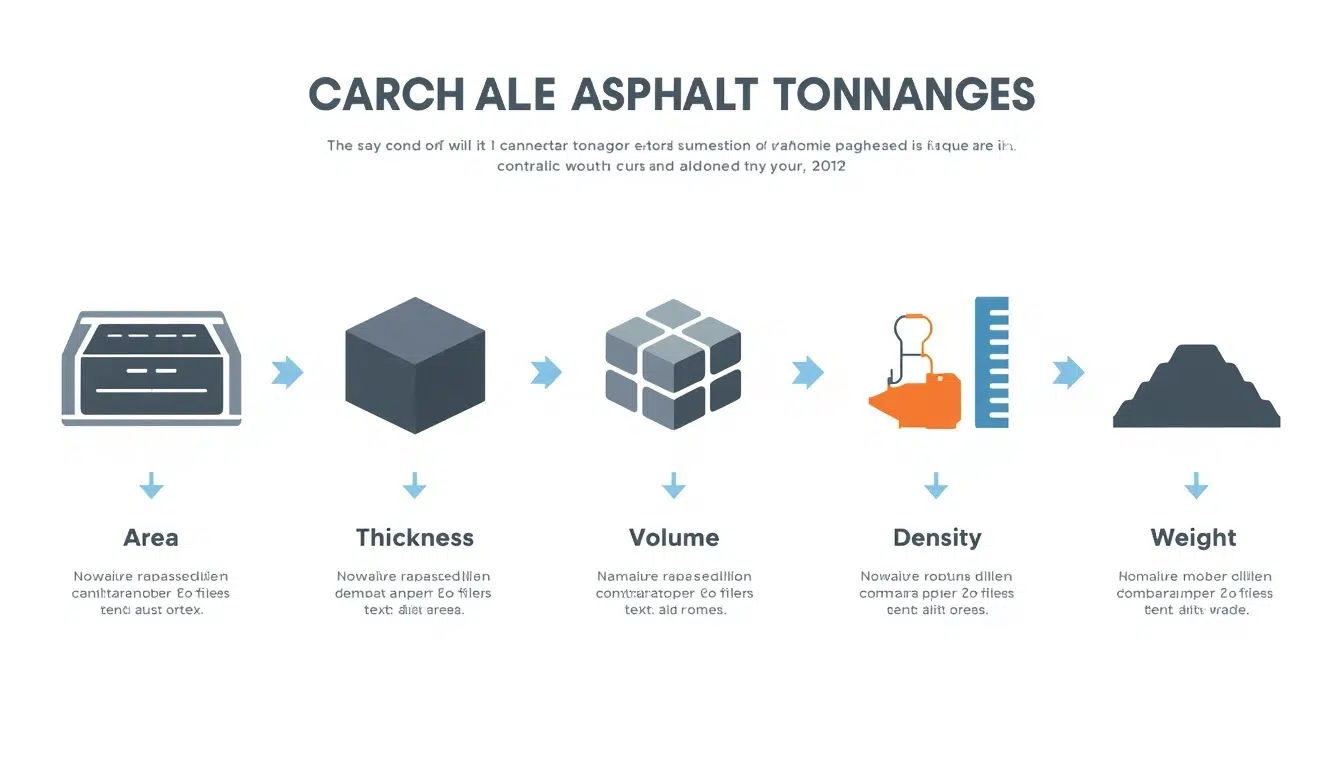
For measurements in square feet, inches, and pounds per cubic foot, the basic formula is:
Asphalt tons = Area × (Thickness ÷ 12) × Density ÷ 2,000
Where:
- Area = paved surface in square feet
- Thickness = compacted asphalt thickness in inches
- 12 = inches in one foot
- Density = asphalt mixture density in pounds per cubic foot
- 2,000 = pounds in one US short ton
Example
Suppose you have:
- Area = 1,000 sq ft
- Compacted thickness = 2 inches
- Density = 145 lb/ft³
First convert the thickness:
2 ÷ 12 = 0.1667 ft
Then calculate volume:
1,000 × 0.1667 = 166.7 ft³
Now calculate weight:
166.7 × 145 = 24,167 lb
Convert to short tons:
24,167 ÷ 2,000 = 12.08 tons
So the theoretical material requirement is approximately 12.1 US short tons before considering project-specific allowances.
The Asphalt Institute provides the same general calculation sequence: determine cubic feet, multiply by asphalt mixture weight per cubic foot, and divide by 2,000 to obtain tons.
How to Calculate Asphalt for a Rectangular Area
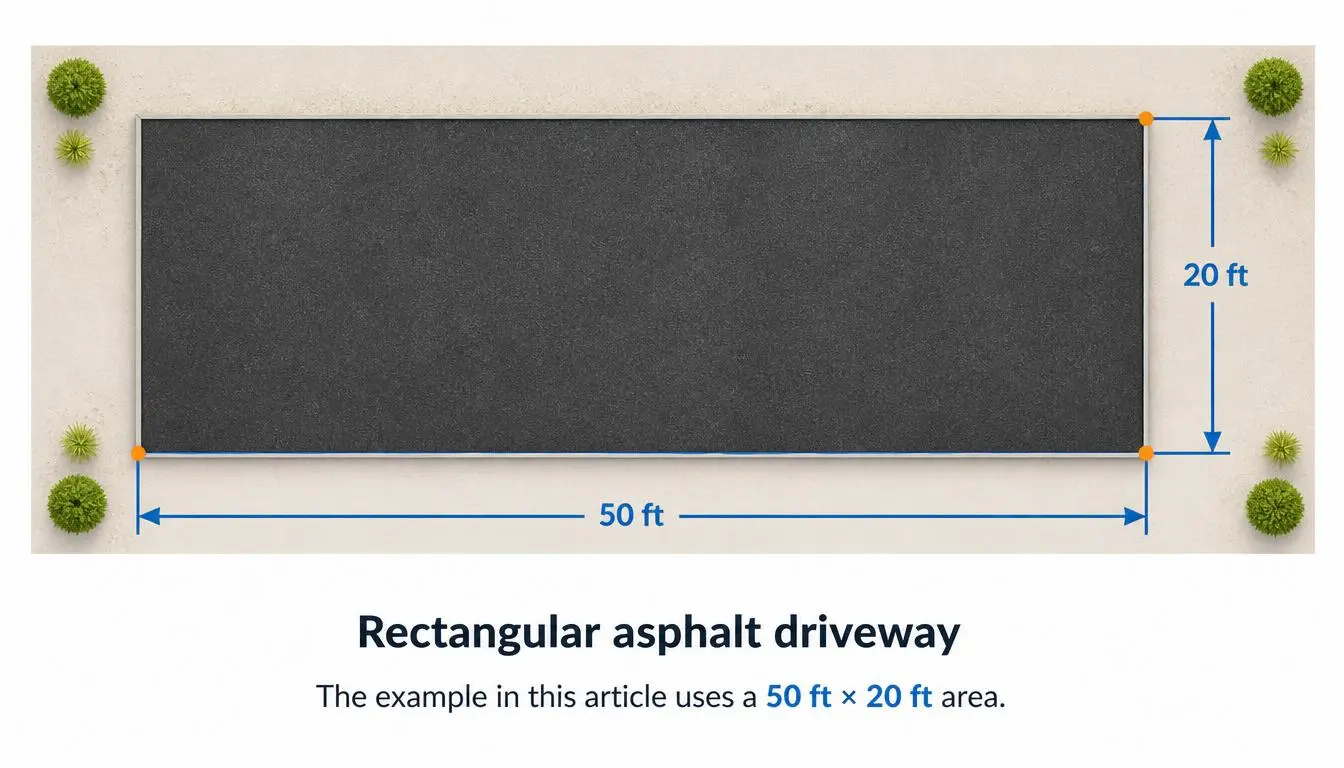
For a simple rectangular project, use this process.
Step 1: Measure the Length
Suppose the driveway is:
50 ft long
Step 2: Measure the Width
Suppose it is:
20 ft wide
Step 3: Calculate Area
50 × 20 = 1,000 sq ft
If your project measurements are given in another area unit, you can use an area converter before continuing.
Step 4: Enter the Compacted Thickness
Suppose the required thickness is:
3 inches
Convert it to feet:
3 ÷ 12 = 0.25 ft
Step 5: Calculate Volume
1,000 × 0.25 = 250 ft³
Step 6: Apply Density
Using 145 lb/ft³ as a planning value:
250 × 145 = 36,250 lb
Step 7: Convert to Tons
36,250 ÷ 2,000 = 18.125 tons
The theoretical requirement is therefore approximately:
18.1 US short tons
This calculation is an estimate. The actual order quantity should be checked against the project specifications and the supplier’s material information.
How to Calculate Asphalt for an Irregular Area
Not every driveway or parking area is a perfect rectangle.
If the surface has several sections, divide it into simple shapes.
For example, an L-shaped area can be separated into two rectangles.
Calculate each section:
Area 1 = Length × Width
Area 2 = Length × Width
Then:
Total Area = Area 1 + Area 2
Once you have the total area, use the same thickness and density calculations.
This approach also works for:
- L-shaped driveways
- T-shaped parking areas
- Walkways
- Road sections
- Multiple paving zones
For areas with curves or complex geometry, use measured dimensions or a site plan rather than relying on rough visual estimates.
Asphalt Calculator: Square Feet to Tons
One of the most common asphalt calculator calculations is converting a known surface area into tons.
The formula is:
Tons = Area × (Thickness ÷ 12) × Density ÷ 2,000
At a planning density of 145 lb/ft³, the approximate theoretical tonnage for 1,000 square feet changes with thickness:
| Compacted Thickness | Approx. Tons per 1,000 sq ft |
|---|---|
| 1 inch | 6.04 tons |
| 2 inches | 12.08 tons |
| 3 inches | 18.13 tons |
| 4 inches | 24.17 tons |
| 5 inches | 30.21 tons |
| 6 inches | 36.25 tons |
These figures are mathematical estimates using the stated density. They should not be treated as universal pavement specifications.
Asphalt Calculator: Tons to Square Feet
You can also work backward.
If you already know how many tons of asphalt you have, you can estimate how much area they will cover.
The formula is:
Square feet = (Tons × 2,000 ÷ Density) ÷ (Thickness ÷ 12)
For example, suppose you have:
- 10 tons of asphalt
- Density = 145 lb/ft³
- Thickness = 2 inches
First calculate the volume:
10 × 2,000 ÷ 145 = 137.9 ft³
Convert 2 inches to feet:
2 ÷ 12 = 0.1667 ft
Then calculate coverage:
137.9 ÷ 0.1667 ≈ 827.4 sq ft
So 10 tons would theoretically cover about 827 square feet at 2 inches compacted thickness at that density.
The relationship is straightforward:
Thicker asphalt = less coverage per ton.
Asphalt Calculator Coverage Per Ton
Using 145 lb/ft³ as the calculation density, the theoretical coverage of one US short ton is approximately:
| Compacted Thickness | Coverage per Ton |
|---|---|
| 1 inch | 165.5 sq ft |
| 2 inches | 82.8 sq ft |
| 3 inches | 55.2 sq ft |
| 4 inches | 41.4 sq ft |
| 5 inches | 33.1 sq ft |
| 6 inches | 27.6 sq ft |
These are calculated values, not guaranteed field coverage.
Actual coverage can differ because of the mixture’s density, grade preparation, compaction, thickness variation, irregular edges, and construction conditions.
How Thickness Changes Asphalt Quantity
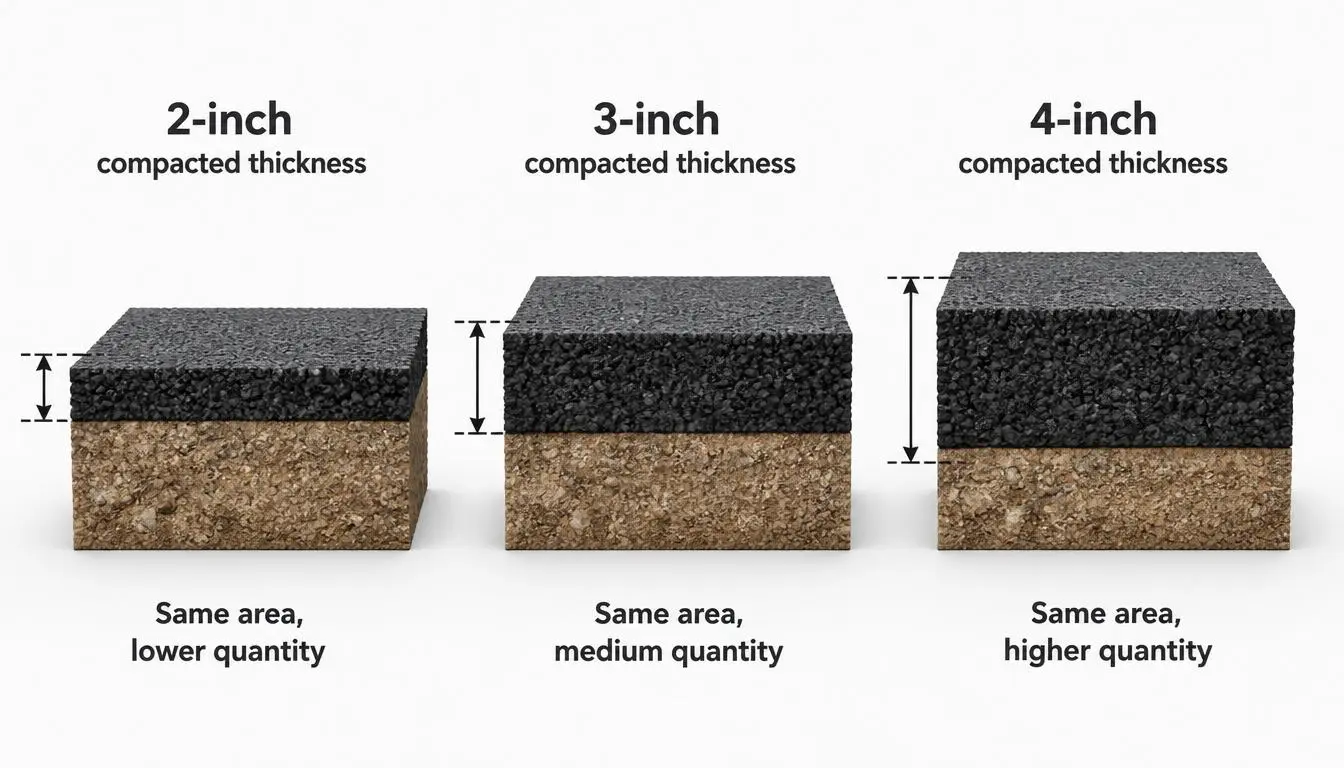
Thickness has a direct effect on tonnage.
Consider the same 1,000 sq ft surface:
- At 1 inch, the theoretical quantity is about 6.04 tons.
- At 2 inches, it is about 12.08 tons.
- At 3 inches, it is about 18.13 tons.
- At 4 inches, it is about 24.17 tons.
The reason is simple. Increasing thickness increases the volume of asphalt occupying the same surface area.
This is why entering the correct depth is just as important as measuring the area correctly.
Do Not Guess the Thickness
The calculator can tell you how much material is needed for a given thickness. It does not determine whether that thickness is appropriate for your project.
Pavement thickness can depend on factors such as:
- Expected traffic
- Vehicle loads
- Existing pavement
- Subgrade conditions
- Aggregate size
- Drainage
- Climate
- Pavement structure
- Local specifications
- Project design
For an engineered pavement or public-road project, use the thickness specified by the applicable design or project documents.
FHWA’s asphalt pavement resources discuss pavement density, construction, mixture design, and related technical considerations.
Compacted Thickness vs. Loose Thickness
This distinction can cause significant calculation errors.
The thickness entered into a material calculation should generally represent the finished compacted thickness when the formula is intended to estimate the in-place pavement quantity.
Asphalt calculator is placed and then compacted. The loose material before rolling does not necessarily occupy the same final volume as the compacted pavement.
Compaction reduces the volume of the asphalt mixture and increases its unit weight or density. FHWA describes compaction as the process of compressing the mixture and reducing air voids while increasing density.
For example, if your project calls for a finished compacted layer of a particular depth, do not simply enter an unverified loose depth and assume the two are interchangeable.
Asphalt Density: Why It Matters
Density connects asphalt volume with asphalt weight.
Two calculations using the same:
- Area
- Thickness
can produce different tonnage if they use different densities.
For example:
Lower density → lower calculated weight for the same volume
Higher density → higher calculated weight for the same volume
This is why a generic density value should be treated as an estimating assumption rather than a substitute for the actual mix information. FHWA provides additional guidance on in-place asphalt pavement density and compaction.
FHWA notes that asphalt mixtures made with different aggregates can have significantly different densities, which is another reason to use project-specific information when available.
Metric Asphalt Calculations
If you work in metric units, the same basic principle applies:
Volume = Area × Thickness
Then:
Mass = Volume × Density
For example, if:
- Area = 100 m²
- Thickness = 50 mm
Convert 50 mm to meters:
50 ÷ 1,000 = 0.05 m
Volume:
100 × 0.05 = 5 m³
If the applicable mix density is 2,325 kg/m³:
5 × 2,325 = 11,625 kg
Convert to metric tonnes:
11,625 ÷ 1,000 = 11.625 tonnes
FHWA lists 2,325 kg/m³ (145.2 lb/ft³) as a hot asphalt mix unit weight for estimating purposes.
For an actual project, use the density associated with the specified mixture.
US Short Tons vs. Metric Tonnes
Do not confuse a US short ton with a metric tonne.
For asphalt calculations:
- 1 US short ton = 2,000 lb
- 1 metric tonne = 1,000 kg
They are not identical units.
If you need to convert between pounds, kilograms, and other weight measurements, you can use the weight converter to check the conversion.
This matters when comparing calculator results with supplier quotes, delivery tickets, or project documents.
How to Estimate Asphalt Cost
If you know the amount of asphalt required and the price per ton, material cost can be estimated as:
Material Cost = Asphalt Tons × Price per Ton
For example:
- Required asphalt = 18 tons
- Price = $X per ton
Then:
Cost = 18 × X
The exact price should come from the current supplier or project quotation because asphalt prices vary by location, mix, transportation, order size, and market conditions.
Material Cost Is Not the Same as Total Project Cost
An asphalt tonnage calculator normally estimates material.
A complete paving project may also involve:
- Site preparation
- Excavation
- Grading
- Aggregate base
- Drainage work
- Tack or prime coat
- Milling or removal
- Labor
- Equipment
- Transportation
- Traffic control
- Disposal
- Permits
- Striping
- Other project-specific work
Therefore, multiplying asphalt tons by the material price does not necessarily give the final installed paving cost.
Should You Add Extra Asphalt?
A theoretical calculation assumes that the measured area, thickness, and density translate perfectly into the finished quantity.
Real projects can be less exact.
Factors such as:
- Irregular edges
- Thickness variation
- Surface irregularities
- Compaction
- Measurement error
- Construction waste
- Small inaccessible areas
can affect the amount required.
An additional allowance may be appropriate for some projects, but there is no single percentage that applies universally. Consider project conditions, supplier practices, compaction, irregular areas, and the required ordering method.
For larger or engineered projects, follow the project takeoff method or supplier guidance rather than adding an arbitrary percentage.
Common Asphalt Calculation Mistakes
1. Using Area Without Thickness
Knowing that an area is 1,000 square feet does not tell you how many tons of asphalt are needed.
You also need thickness and density.
2. Forgetting to Convert Inches to Feet
If your density is in pounds per cubic foot, thickness in inches must be converted to feet:
Thickness in feet = Thickness in inches ÷ 12
Forgetting this conversion can make the result dramatically incorrect.
3. Mixing Metric and Imperial Units
Do not combine:
- Square feet with meters
- Inches with kilograms per cubic meter
- Pounds per cubic foot with cubic meters
unless you perform the appropriate conversions.
4. Using the Wrong Density
A generic calculator default may not match your actual asphalt mix.
If the supplier or project documentation provides a density, use that value.
5. Confusing Loose and Compacted Thickness
The final pavement thickness and loose material thickness are not automatically interchangeable.
6. Treating a Calculator as a Pavement Design Tool
A calculator estimates material quantity.
It does not determine:
- Structural pavement design
- Suitable base thickness
- Drainage design
- Traffic loading requirements
- Required mix specification
- Local construction compliance
7. Rounding Too Early
Keep several decimal places during the calculation and round the final result.
8. Ignoring Irregular Shapes
Using a simple length × width calculation for a complex surface can overestimate or underestimate the actual area.
Break irregular areas into manageable sections instead.
Asphalt Calculator for Driveways
A driveway calculation normally begins with the paved area and finished asphalt thickness.
For a rectangular driveway:
Area = Length × Width
Then:
Tons = Area × (Thickness ÷ 12) × Density ÷ 2,000
For example, a 600 sq ft driveway at 3 inches and 145 lb/ft³ gives:
600 × (3 ÷ 12) × 145 ÷ 2,000
= 10.875 tons
So the theoretical quantity is about 10.9 tons before any project-specific allowance.
The appropriate pavement structure, however, should not be selected solely from this calculation. Existing base conditions, traffic, drainage, local practice, and project specifications matter.
Asphalt Calculator for Parking Lots
Parking lots can have significantly different loading conditions depending on whether they serve:
- Passenger cars
- Delivery vehicles
- Buses
- Heavy trucks
- Industrial equipment
Because traffic loading affects pavement design, you should not select asphalt thickness simply because a calculator accepts that number.
Use the calculator to determine the quantity after the required pavement thickness has been established.
Asphalt Calculator for Roads
Road projects can be more complex than driveways and small parking lots.
A road may involve:
- Multiple lanes
- Different pavement layers
- Shoulders
- Curves
- Variable widths
- Multiple asphalt lifts
- Base and subbase layers
- Drainage structures
- Different traffic loading
For a simple quantity estimate, divide the road into sections and calculate each section separately.
For an engineered road project, use the project’s plans, specifications, and approved quantity takeoff.
FHWA maintains technical resources covering asphalt pavement design and construction, including density, compaction, mixture design, and construction practices.
Asphalt Volume vs. Asphalt Weight
These two results are related but not the same.
Volume
Volume tells you how much physical space the asphalt occupies.
Common units include:
- Cubic feet
- Cubic yards
- Cubic meters
Weight
Weight tells you how heavy the asphalt mixture is.
Common units include:
- Pounds
- Kilograms
- US short tons
- Metric tonnes
The relationship is:
Weight = Volume × Density
This distinction is useful when checking supplier information.
A supplier may quote asphalt by ton while your measurements are based on square feet and inches.
How Accurate Is an Asphalt Calculator?
An asphalt calculator can be mathematically accurate while the final material order is still different from the calculation.
The reason is that the calculator works from the information you provide.
If the following are accurate:
- Area
- Compacted thickness
- Density
- Unit conversions
then the mathematical estimate will be reliable for those assumptions.
But the real project can vary because of:
- Actual mix density
- Field compaction
- Uneven surfaces
- Measurement uncertainty
- Irregular edges
- Construction losses
- Changes in thickness
- Supplier loading and delivery practices
So it is better to think of the result as a quantity estimate based on stated assumptions, not a guarantee of the exact number of tons that will be delivered or consumed.
How to Check Your Asphalt Calculation
A quick sanity check can catch many errors.
Check 1: Confirm the Area
For a rectangle:
Length × Width = Area
Check 2: Check the Thickness Unit
If thickness is in inches and density is in lb/ft³:
Divide inches by 12.
Check 3: Check the Density
Make sure the density is in the correct unit.
Check 4: Check the Ton Unit
For US short tons:
2,000 lb = 1 short ton
Check 5: Compare the Result With a Second Method
You can calculate:
- Area
- Volume
- Weight
- Tons
step by step instead of relying only on the calculator’s final number.
If both methods agree, your arithmetic is probably consistent.
Quick Asphalt Calculation Reference
Using 145 lb/ft³ as a planning density:
| Measurement | Formula |
|---|---|
| Rectangular Area | Length × Width |
| Thickness in Feet | Inches ÷ 12 |
| Asphalt Volume | Area × Thickness |
| Asphalt Weight | Volume × Density |
| US Short Tons | Weight ÷ 2,000 |
| Cost | Tons × Price per Ton |
| Coverage | Available Volume ÷ Thickness |
The exact density should be replaced with the applicable project or supplier value when available.
What Information Should You Have Before Using an Asphalt Calculator?
Before starting, collect:
- Length
- Width
- Total area, if already known
- Required compacted thickness
- Asphalt mix density, if available
- Measurement units
- Price per ton, if estimating material cost
- Any project-specific quantity allowance
For an irregular project, also prepare a simple sketch or divide the surface into smaller measurable sections.
The better your input measurements, the more useful the estimate will be.
Asphalt Calculator vs. Manual Calculation
| Method | Advantage | Limitation |
|---|---|---|
| Online calculator | Fast and convenient | Depends on correct inputs |
| Manual formula | Transparent and easy to verify | More opportunity for arithmetic errors |
| Contractor takeoff | Can account for project details | Requires project information and expertise |
| Supplier estimate | Uses supplier-specific material information | May not include every project cost |
For a small project, an online calculator can be a useful first estimate. For a large or technically specified project, it should support rather than replace the formal quantity takeoff.
Final Takeaway
An asphalt calculator converts a few practical measurements into an estimated asphalt quantity.
The core process is straightforward:
Measure the area → choose the required compacted thickness → calculate volume → apply asphalt density → convert to tons.
The most important inputs are area, compacted thickness, and density. If you know the current price per ton, you can also estimate material cost.
For simple projects, this provides a quick way to plan material requirements. For larger or engineered paving work, use the calculator alongside the project’s specifications, quantity takeoff, and supplier information.
The key is not simply getting a number. It is understanding the assumptions behind that number so you know whether it makes sense for the project.
Frequently Asked Questions
How do I calculate how many tons of asphalt I need?
Multiply the paved area in square feet by the compacted thickness in feet and the asphalt density in pounds per cubic foot, then divide by 2,000.
Tons = Area × Thickness × Density ÷ 2,000
If thickness is entered in inches, divide it by 12 first.
How many tons of asphalt do I need for 1,000 square feet?
At 145 lb/ft³, approximately 12.1 tons at 2 inches, 18.1 tons at 3 inches, and 24.2 tons at 4 inches are required theoretically.
The actual quantity depends on the specified thickness and mix density.
How many square feet does one ton of asphalt cover?
At 145 lb/ft³, one US short ton theoretically covers about 82.8 sq ft at 2 inches, 55.2 sq ft at 3 inches, and 41.4 sq ft at 4 inches.
Actual field coverage can vary.
What density should I use for asphalt?
If you do not have project-specific information, around 145 lb/ft³ can be used as a planning value for hot-mix asphalt. FHWA lists 145.2 lb/ft³ as an estimating unit weight for hot asphalt mix, while the Asphalt Institute gives a typical in-place range of approximately 142 to 148 lb/ft³.
For an actual order, use the density supplied for the applicable mix whenever possible.
Should asphalt thickness be compacted or loose?
For a calculation based on finished pavement quantity, use the required compacted thickness. Do not automatically treat loose placement depth as the finished thickness.
Can I calculate asphalt for an irregular driveway?
Yes. Divide the driveway into simple shapes such as rectangles, calculate each area, and add them together before calculating the total asphalt quantity.
How do I calculate asphalt cost?
Multiply the estimated asphalt tonnage by the current price per ton:
Cost = Tons × Price per Ton
This estimates material cost only unless the calculator includes additional project expenses.
Does asphalt density affect the result?
Yes. A higher density produces a higher calculated weight for the same volume, while a lower density produces a lower calculated weight.
Is an asphalt calculator accurate enough for ordering?
It can provide a useful estimate, but the final order should be checked against the project specifications and the supplier’s mix information. Actual conditions can cause the required quantity to differ from a theoretical calculation.
Can I use an asphalt calculator for roads and parking lots?
Yes, for material quantity calculations. However, the calculator does not determine the correct structural pavement thickness or complete road design. Those requirements depend on the project.
What is the difference between a ton and a tonne?
A US short ton equals 2,000 pounds, while a metric tonne equals 1,000 kilograms. They are different units and should not be mixed during calculations.
What is an asphalt calculator used for?
It estimates asphalt volume, weight, tonnage, coverage, and potentially material cost from project dimensions and pavement thickness.
What is the basic asphalt tonnage formula?
Tons = Area × (Thickness ÷ 12) × Density ÷ 2,000
What is a common planning density for asphalt?
Approximately 145 lb/ft³ is a useful planning value for hot-mix asphalt, but the applicable mix density should be used whenever available.
How much asphalt covers 1,000 square feet?
At 145 lb/ft³, approximately 12.1 tons at 2 inches, 18.1 tons at 3 inches, and 24.2 tons at 4 inches.
Can the calculator estimate cost?
Yes, if you enter the applicable price per ton. The result should be treated as a material-cost estimate unless other project costs are included.
Should I add extra asphalt to the calculated amount?
An allowance may be appropriate for some projects, but there is no single percentage that applies to every job. Consider project conditions, supplier practices, compaction, irregular areas, and the required ordering method.